SERVICES
Local competitor research on DoorDash and Uber Eats
We research every restaurant competing with you on DoorDash and Uber Eats near your store: what they discount, how they price, how they're rated, how their menus are built and whether they're paying for placement. Then we show you how you're positioned against them, and what we'd change first.
For owners who want to know why a customer scrolling the app picks the place down the road, before spending another dollar on promos.
WHY IT MATTERS
Why research your competitors on the delivery apps?
On the apps, your restaurant is one tile in a scroll of nearby options. A customer compares you with the place next door in a few seconds, on a phone, using what's on the screen: the price, the picture, the rating and whatever offer is attached.
The order matters. "The first thing people look at is price. Picture comes second, description comes third." Then trust. Is the rating 4.5 or above? How many reviews are behind it? A campaign can get you seen, but whether people order comes down to how you look next to the stores around you.
Without looking at those stores, every decision is a guess. You can run a BOGO when your neighbors already discount nine items. You can cut a price that was already the lowest on the block. The platform rep won't tell you, because the suggestions in the portal are built around the platform's revenue, not around the shop down the road.
"Campaigns do improve the visibility but conversion relies on trust signals like, hey, is it 4.5 or above? How many reviews it has."
Hassan Shaikh, founder
WHAT'S INCLUDED
What do you get from a competitor analysis?
A clear picture of your local market on the apps, and a short list of what to do about it.
- A local competitor setRestaurants within a set straight-line distance of your store, covering your category and the places customers pick instead of you.
- The marketplace, as customers see itWe look at each store's public DoorDash and Uber Eats page the way a customer does, on a phone, not at your own storefront link.
- The same checklist for every storeOffers, prices, menu build, ratings, photos, ads, fees and hours, recorded the same way, so the comparison is fair.
- A deck with tight screenshotsSmall, representative crops. If a competitor runs BOGOs on 15 items, you see a few of the tagged items, not 15 pages of menu.
- A positioning summaryWhere you lead, where you trail, and where nobody nearby is competing at all.
- Recommendations you approveOnly after the research is done. Each one comes with the observation behind it and an approval line. Nothing changes without your sign-off.
- A recheck when the market movesA new store opens, a neighbor launches a big offer, a rival climbs the rankings. We look again before anyone reacts.
- Findings that go straight into the planThe research feeds your campaign strategy, menu, prices and photos, run by the same team.
HOW WE DO IT
How do we research your competitors?
Research first, recommendations after. Mixing the two is how you end up copying the loudest competitor instead of the one that's winning.
Set the radius by distance
We map competitors by straight-line distance from your store. Delivery time is too variable to build a list on. It changes between lunch and 3pm, in the rain, and with how many drivers are out.
Pick the stores that matter
Your direct category first, then the places a customer would order instead. A burger shop also competes with the chicken sandwich place two blocks over.
Look at each store like a customer
We open every competitor's DoorDash and Uber Eats page on a phone and record the same checklist for each one, close together in time, so the snapshot is consistent.
Go item by item on offers and prices
How many items each competitor discounts and which ones, how those items are priced and whether they're the popular ones, and how comparable items line up against yours.
Write the positioning summary
Where you stand on price, trust, photos and offers against the stores around you, backed by a few clean screenshots rather than a wall of them.
Then make the recommendations
A short list, each tied to what we saw. Some are quick fixes, like photos. Some become tests in your next month of campaigns. You approve each one.
WHAT WE COMPARE
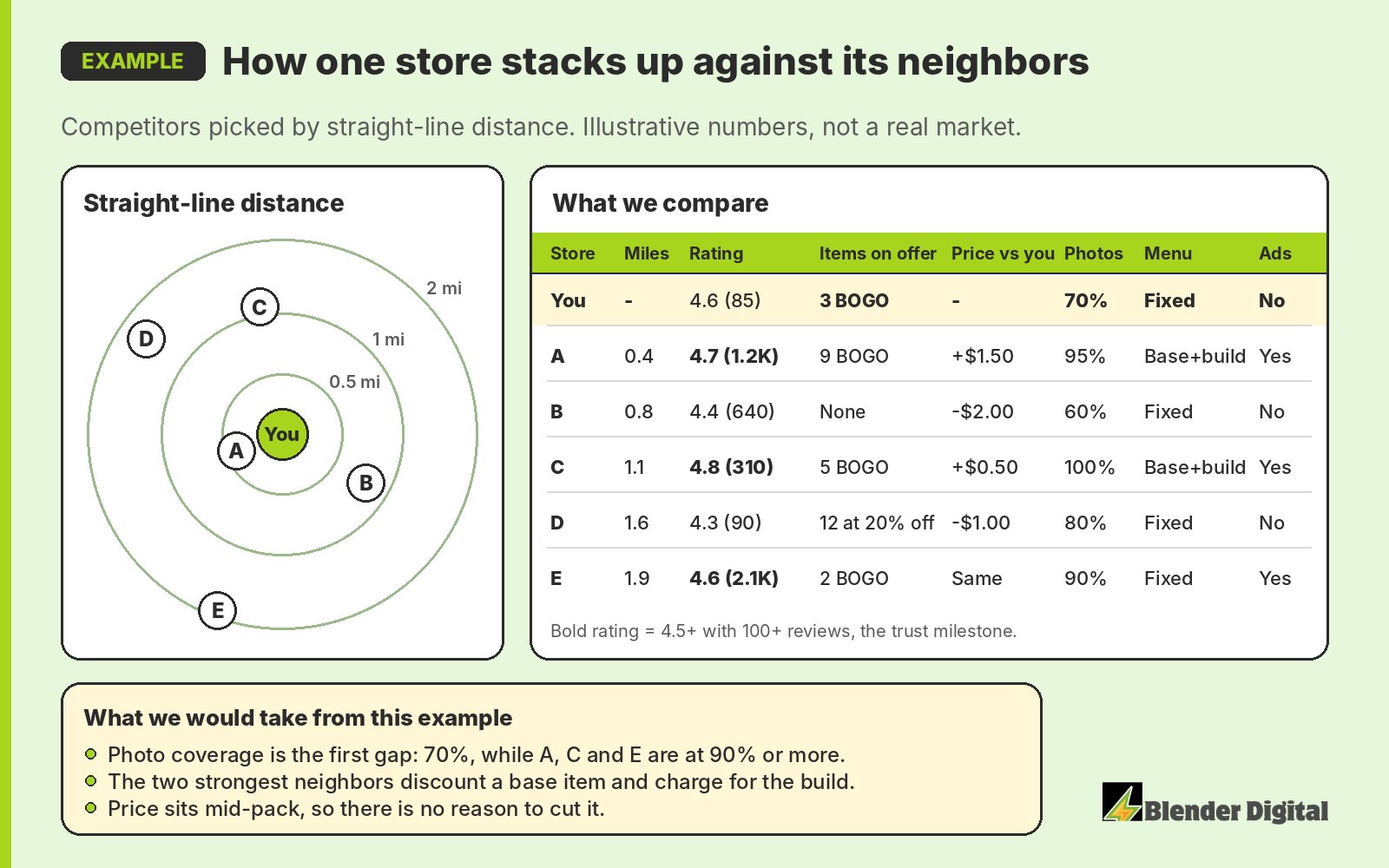
What do we look at for each competitor?
The things a customer sees before they tap, plus the ones that tell you how a competitor is protecting its margin.
Offers, item by item
How many items each competitor discounts, which ones, how they're priced and whether they're marked popular. Nine BOGO items and one BOGO item are very different strategies.
Price ladder
Comparable items side by side, yours and theirs. Price is the first thing a customer reads, so this is where we start.
Base-and-build or fixed menu
Whether a competitor sells a base item with paid add-ons, like a required "meal style" choice on a burger, or fixed items. It shows how they keep a discount from eating their margin.
Rating and review count
4.5 or higher with 100+ reviews is the trust milestone. A 4.5 on 150 reviews says more than a 4.2 on 1,000.
Photo coverage
The share of menu items with a photo, judged on mobile. We aim for 90 to 95%+ on our clients' menus, so we check where the neighbors are.
Sponsored placement
Who shows up in sponsored listings and ads when a customer browses your category. It tells you who is buying the top of the feed.
Fees and memberships
Delivery fees, and whether a competitor takes part in DashPass and Uber One, which changes what members pay at checkout.
Hours
Who's open when you're closed. Late nights and the days you're dark are often where the gaps are.
Your own storefront
The same checklist run on your store, so every finding is a direct comparison and not an opinion.
Want to check your own pricing first? Try the markup parity calculator.
IN PRACTICE
What does competitor research change?
Two moments from recent engagements and one illustrative example. Clients are anonymized.
"Don't react to just the competition moving in."
Hassan Shaikh, founder
ONE PLAN
Research that turns into campaigns, not a report on a shelf
A market report tells you what the neighbors are doing. It doesn't change your offers, fix your photos or test a new price. In a Blender Digital plan, the people who research your competitors are the same people who run your campaigns, so the findings go to work the following month.
A one-off market report
- Observations you read and act on yourself
- Nobody turns it into offers, prices or photo fixes
- No follow-up to see if the changes worked
- Out of date when the next store opens
One Blender Digital plan
- Research at kickoff and again when the market shifts
- Recommendations go into your campaign plan, menu and photos
- Results measured in your monthly report
- One provider and one fee, from $1,030 a month on a 6-month program
FAQ
Competitor research questions
What does a DoorDash and Uber Eats competitor analysis include?
For every restaurant competing with you nearby, we record what they discount and on how many items, how their prices compare with yours on similar items, whether their menu is built from a base item with paid add-ons or as fixed items, their rating and review count, how many menu items have a photo, whether they're paying for sponsored placement, their delivery fees and DashPass or Uber One participation, and their hours. You get it as a deck with screenshots, a positioning summary and our recommendations.
How do you decide which competitors to compare against?
By straight-line distance from your store, not by delivery time. Delivery time changes with the hour, the weather and how many drivers are out, so a list built on it changes too. Distance stays put. Inside that radius we include your direct category and the places a hungry customer would pick instead of you.
A new competitor just opened near me. Should I lower my prices?
Usually not. Don't react to just the competition moving in. A busy new opening brings more people to the apps in your area, and some of them end up ordering from you. One of our clients, a smash-burger ghost kitchen in Houston, had its best day ever when a hyped competitor opened nearby. We'd look at the new store first, then decide if anything needs to change.
Do you look at Grubhub competitors too?
The research centers on DoorDash and Uber Eats, because that's where most delivery orders and most of the competition are. When Grubhub is a meaningful share of your sales, we include it.
Can I buy a competitor analysis on its own?
Competitor research is part of every program. It's done at the start of the engagement, and again when the market shifts, because the findings feed straight into your campaigns, prices and menu. If a one-time audit is all you need, bring it up on the discovery call and we'll tell you honestly whether we can help.
How do you stack up against the stores near you?
In a free 30-minute call we'll pull up your DoorDash and Uber Eats pages next to a few nearby competitors and tell you what stands out.