
DoorDash charges restaurants 15%, 25% or 30% of every delivery order, depending on the plan you pick. Uber Eats charges 20%, 25% or 30%, after it raised its lowest plan from 15% in March 2026. Grubhub works out to roughly 15% to 30% once you add its delivery fee. Pickup orders cost much less, about 6% to 7% on DoorDash and Uber Eats.
Those are rack rates, the prices for a restaurant that signs up online and never asks for anything. I manage these accounts every day, and the number on the pricing page is the starting point for the conversation. Below are the current plans (as of October 2026), how the money actually gets taken, and what I ask the platforms for.
How much does DoorDash charge restaurants?
DoorDash has three Marketplace plans. Basic is 15% per delivery order, Plus is 25% and Premier is 30%. Pickup is 6% on all three. There's no monthly fee and no signup fee, and DoorDash says the commission covers card processing. New stores get 0% for the first 7 days on Basic and the first 30 days on Plus or Premier (DoorDash pricing page).
What changes between plans is how far you deliver and how much the customer pays for delivery. Plus adds a wider delivery radius, a lower delivery fee for the customer and access to DashPass members. Premier adds the widest range, a sponsored listing, a $200 food styling credit and a guarantee that refunds your commission in months you get fewer than 20 orders.
I recommend Plus for most restaurants. Basic keeps you local and can't reach DashPass customers, and I've watched it stall a store. A Yemeni coffee house we worked with in Atlanta sat on Basic, and its DoorDash sales went flat until it moved up. Premier's extras are mostly a marketing trick. "Customers pay the lowest fees" really means DoorDash is passing those customer fees over to you through the higher commission. The one Premier perk I value is the sponsored listing boost.
Two details people miss. The 6% pickup rate requires your DoorDash pickup prices to match your in-store prices. And these standard plans are only for restaurants with 75 or fewer US locations. Bigger groups are a different conversation.
What is the Uber Eats commission for restaurants in 2026?
Uber Eats calls it a marketplace fee. Lite is 20%, Plus is 25% and Premium is 30%. Pickup is 7% if Uber can confirm your app prices match in-store, and 10% if it can't. Plus and Premium start at 0% for your first 30 days (Uber Eats pricing page).
The March 2026 change matters here. Starting March 11, Lite went from 15% to 20%, pickup went from 6% to 7%, and Uber One member orders on Plus went to 30%. Restaurants that already had a custom rate saw it rise 3 points, capped at 30% (Restaurant Dive, March 10, 2026). If you negotiated a rate before March, check your statement. It may not be the rate you agreed to anymore.
The Uber One piece is the one that catches people. On Plus you pay an extra 5% on orders from Uber One members, so those orders cost 30%. Lite stores can't take part in Uber One at all. Premium includes it, plus an ad credit match of up to $100 a month and a menu photo package. They figured out a way to nickel-and-dime restaurant owners on almost every line, so read the plan details, not just the headline rate.
Uber also lists lower Lite rates in a few cities (15% on delivery in Portland, Washington DC, Los Angeles and Seattle) and a 3% card processing fee in New York City.
What does Grubhub charge restaurants?
Grubhub splits its fee in two. The marketing commission is 5% on Basic, 15% on Plus and 20% on All-access. If Grubhub drivers deliver your orders, delivery fees start at 10% on top. Payment processing is charged separately (Grubhub Marketplace page). So a delivered order runs from about 15% to 30% plus processing.
One thing to know: the marketing fee applies to pickup orders too, so a Plus store pays 15% on pickup, against about 6% to 7% on the other two apps.
Grubhub is about 5% to 10% of the market in most places I work. I keep clients on it as a market play, but there's no point over-optimizing for it.
DoorDash vs Uber Eats vs Grubhub plans, side by side
Published rates as of October 2026. Your account can be different, so check your own agreement.
| Plan | Delivery | Pickup | What the higher tiers add |
|---|---|---|---|
| DoorDash Basic | 15% | 6% | Local delivery area, free menu photoshoot. 0% for 7 days. |
| DoorDash Plus | 25% | 6% | Wider radius, lower customer delivery fee, DashPass members. 0% for 30 days. |
| DoorDash Premier | 30% | 6% | Widest range, sponsored listing, $200 styling credit, 20-order guarantee. 0% for 30 days. |
| Uber Eats Lite | 20% | 7% (10% unvalidated) | Listed in the app. No Uber One. |
| Uber Eats Plus | 25% (30% on Uber One orders) | 7% | Lower customer delivery fee, ads and offers visibility. 0% for 30 days. |
| Uber Eats Premium | 30% | 7% | Lowest delivery fee, Uber One included, up to $100 a month ad match, photo package, 20-order guarantee. 0% for 30 days. |
| Grubhub Basic / Plus / All-access | 5% / 15% / 20% marketing, plus delivery from 10% | Marketing fee applies | Lower customer delivery fee at each step up. Processing extra. |
Not sure which DoorDash plan fits? See DoorDash Basic vs Plus vs Premier: which plan to pick.
Sources: DoorDash, Uber Eats, Grubhub. Guarantees and intro rates have conditions; read the footnotes.
How do you actually pay DoorDash and Uber Eats?
You don't. Not in the sense of a bill. The customer pays the app, the app keeps its share, and you get what's left. Nothing for commission or promos comes out of your bank account separately.
DoorDash describes it this way on your statement: net total equals sales, minus commission and fees, minus marketing spend, plus or minus adjustments like error charges (DoorDash payout guide). Payouts land weekly by default, and DoorDash offers daily deposits through Fast Pay. Uber Eats pays weekly too, and its payout week closes late Sunday night, so your weekly total won't line up with your POS.
What gets withheld before you see a dollar:
- Commission at your plan's rate.
- Promotions you fund, like a BOGO or $5 off.
- Offer fees. Both apps charge about $0.99 for every redeemed offer.
- Ads. Sponsored listing spend comes out of your payouts.
- Error charges for missing or wrong items, unless you win the dispute.
A few things to check if a payout looks wrong. A missing W-9 on Uber Eats triggers a 24% withholding, which explained one owner's "Uber is scamming me." On Grubhub, make sure direct deposit is actually set up. One store I looked at had $996 sitting unpaid. For a deeper look at what's left after all of this, I broke it down in how much delivery revenue you actually keep.
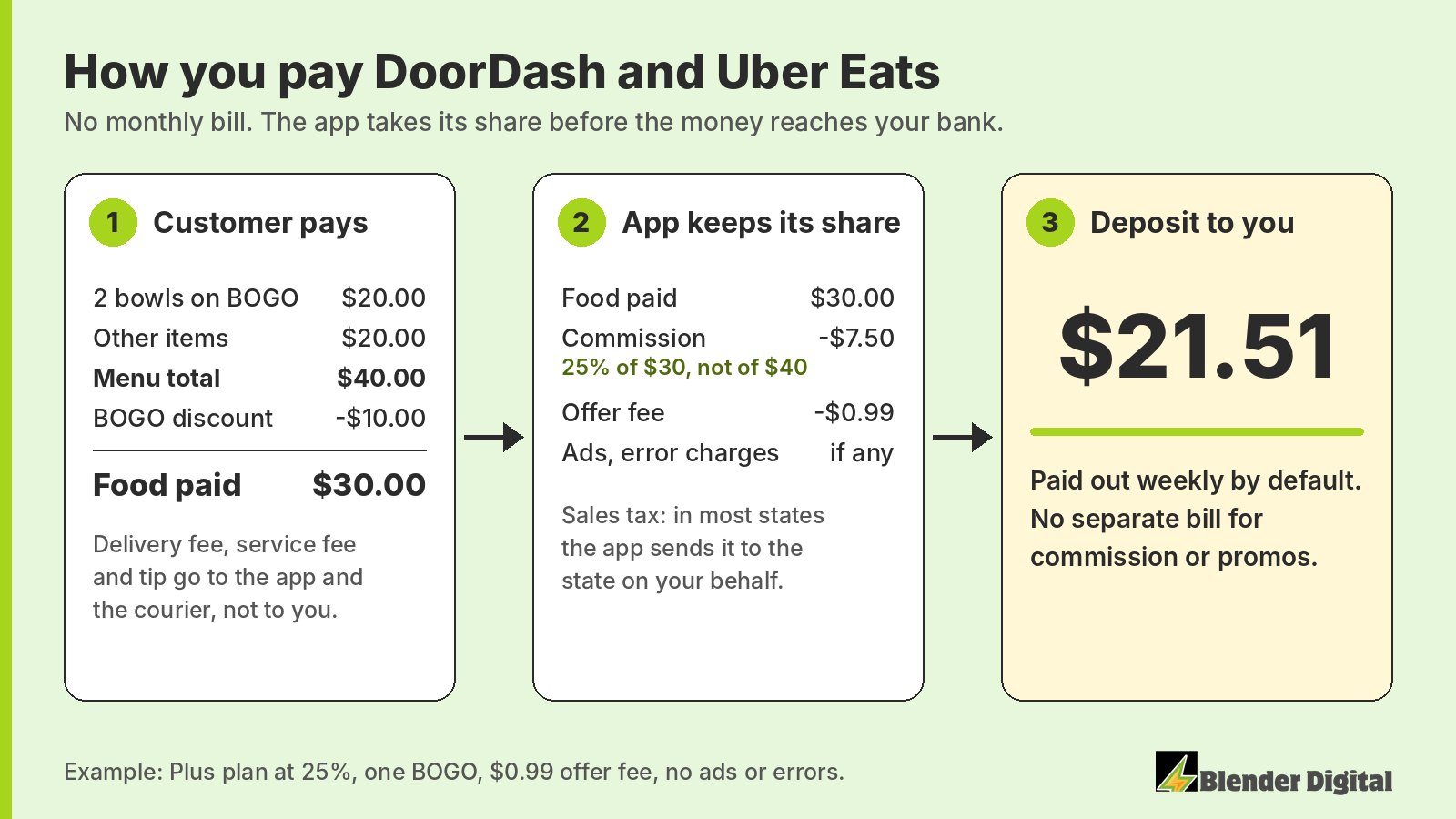
Is commission charged on the menu price or after the discount?
After the discount. DoorDash puts it in writing: "Your commission rate is applied to the order subtotal, less free items / discounts" (DoorDash promotions FAQ). That cuts both ways. You don't pay commission on food you gave away, but you still carry the full cost of the promotion yourself.
Example: a $40 order with a BOGO, on a 25% plan
| Two $10 bowls on BOGO, plus $20 of other items | $40.00 at menu prices |
| BOGO discount (you fund it) | -$10.00 |
| Food the customer paid for | $30.00 |
| Commission: 25% of $30, not of $40 | -$7.50 |
| Offer fee | -$0.99 |
| Your payout for this order | $21.51 |
Sales tax, the delivery fee, the service fee and the tip are handled separately. They never count toward your $21.51.
Two things follow from this. Your promo cost is never on a bill. It shows up as a smaller payout, which is why owners feel the money "should be here" and can't find it. And you're paying for the free bowl twice: once in revenue you gave up, and again in the food cost to make it. That's why I only put BOGOs on items with a 75% margin or better. If you want to see where commission, promos and everything else add up, read the true cost of selling on DoorDash and Uber Eats.
Who pays the sales tax on DoorDash and Uber Eats orders?
The customer pays it at checkout, and in most states the app sends it to the state for you. Most states treat the delivery apps as marketplace facilitators, which moves the job of remitting sales tax from you to the platform. That tax doesn't come out of your share.
There are exceptions. DoorDash now passes certain local taxes, like food and beverage taxes, into some restaurants' payouts for the restaurant to remit, and in states without facilitator rules the restaurant still files (DoorDash tax guide). Your monthly statement shows what the app remitted and what it passed to you. Give that statement to your accountant and let them confirm it.
Can you negotiate DoorDash and Uber Eats commission?
Yes. The platforms want restaurants on their apps and they want them to grow, so they offer custom pricing more often than most owners realize. The timing and what you bring to the table decide what you get.
At launch. This is the easiest moment. Both apps publish 0% intro windows, and I've seen a new store get 0% commission for its first 2 months. Whatever window you get, go aggressive with campaigns while it lasts. DoorDash rarely funds much. It usually gives a small credit on your first sponsored listing, and new stores can get a store-level Smart Campaign credit (one we saw was $150).
When they see you as a strategic partner. If you're planning several locations, opening strong or doing serious volume, the conversation changes. On Uber Eats, around $10K to $15K a month or multiple units is when you start getting noticed by an account manager. Deals I've seen:
- Premier's benefits at a 25% to 26% commission. When owners push back on Premier, reps do this all the time.
- 18% to 20% for groups of 15 to 30 locations.
- 15% for a franchise group that put every location on the top plan.
- Promotion co-funding on Uber Eats of 10% to 25% of your discount, depending on the rep. A smash-burger ghost kitchen we run in Houston got 10% co-funding after we laid out the numbers in writing and followed up four times.
- Exclusivity deals. Once a store does about $12K to $15K a month on one platform, the platforms start asking. Exclusives come with co-funding, credits, a nudge in the algorithm and a lower rate.
It's a trade, and I say it plainly to reps: "We'll run these campaigns and we'll run this much sponsored listing daily spend, but you need to give us a better deal on our commission rate." Your volume on one app also gives you bargaining power with the other. And it isn't a one-time thing. If your numbers keep growing, you can keep asking.
What should you watch out for in a custom deal?
- Deals vary store to store. What a 20-location group got tells you nothing about what your single store will get. Don't anchor on someone else's number.
- Intro rates expire. Write down the end date. If you didn't run campaigns during the 0% window, you paid full price for a slow start.
- Exclusivity costs you bargaining power. I don't recommend it for a single location. You give up the other app's customers and your bargaining power at the next renewal.
- Plan features are hidden in the tiers. Only DoorDash plans at 25% and up reach DashPass members. Uber Lite can't touch Uber One. A cheaper plan can cost you the customers who order most.
- Pickup rates depend on price matching. DoorDash's 6% and Uber's 7% assume your app pickup prices match in-store. One client was being charged 10% on Uber pickup.
- Rate changes reach custom deals too. Uber's March 2026 increase added 3 points to custom rates.
- Cold "pricing specialist" calls. If someone offers "Top 10" placement in exchange for cutting your prices, I'd decline.
What to ask for: a negotiation checklist
- A lower commission rate, or the top plan's perks at a mid-tier rate.
- A longer 0% window at launch, with the end date in writing.
- Ad credits for your first sponsored listings, and an extension when credits are about to expire.
- Promotion co-funding, especially on Uber Eats.
- Credit-backs when a campaign the rep built goes wrong.
- A named account manager if you're multi-location or growing fast.
- For exclusivity: the rate, the co-funding, the length and how you get out.
What you can offer back: committed campaigns, a set daily ad budget, new locations and volume.
After any change, check the first statement line by line. The rate you agreed to on a call and the rate on your statement aren't always the same.
What should you do with these numbers?
Price for them. A 30% markup doesn't cover a 30% commission, and I explain why in this post on menu markup. Run your own menu through the markup parity calculator at the rate you actually pay. If you're still deciding whether to join the apps at all, start with which app and which plan a new restaurant should pick. And if you're on Toast and weighing its delivery option, Toast Delivery Services and the marketplaces do different jobs.
FAQ
How much does DoorDash charge restaurants per order?
DoorDash charges 15% on Basic, 25% on Plus and 30% on Premier for delivery orders, and 6% for pickup, as of October 2026. There's no monthly or signup fee. The commission is taken out of each order before you're paid.
What is the Uber Eats commission for restaurants?
Uber Eats charges 20% on Lite, 25% on Plus and 30% on Premium, with pickup at 7% (10% if your prices aren't validated). Plus adds 5% on Uber One member orders. Lite went from 15% to 20% on March 11, 2026.
Do I pay DoorDash or Uber Eats a monthly fee?
No. Neither sends a monthly bill for marketplace orders. Commission, promotions you fund, offer fees, ad spend and error charges are all withheld from your sales, and the rest is deposited weekly.
Is commission charged on the full menu price or after a promotion?
After the promotion. DoorDash applies commission to the order subtotal less free items and discounts. On a $40 order with a $10 BOGO discount, a 25% commission is $7.50 on $30, not $10 on $40. You still carry the $10 promo cost.
Can you negotiate DoorDash and Uber Eats commission rates?
Yes. Platforms offer launch windows, credits, co-funding and lower rates, especially to multi-location groups and fast-growing stores. Offer committed campaigns and ad spend in return, and confirm the new rate on your next statement.
Not sure if you're on the right plan, or whether you're paying the rate you were promised? Send me your last full month from each app and I'll tell you what I'd ask your reps for. Get in touch here.