
SERVICES
DoorDash, Uber Eats and Grubhub campaign management, tied to a goal
We run your promotions, BOGOs, sponsored listings and loyalty offers on the delivery apps. We check them every week, report on them every month, and set the strategy behind them, so every campaign has a job: more sales, more new customers, or a better payout, at a cost that makes sense for your restaurant.
Built for independent restaurants and multi-location groups that don't have hours to spend inside three merchant portals.
WHY IT NEEDS A MANAGER
Anybody can switch on a BOGO. Running it at a profit takes work.
The apps make it two clicks to launch an offer, and the portals will always suggest a bigger budget. That suggestion is built around the platform's revenue. It doesn't know your food cost, your kitchen's capacity or what you need to clear each month.
Campaigns also drift when nobody is watching. Sponsored listings go stale if the budget sits at the same level for too long. Ad credits expire unused. Editing an item in your POS can change its ID and quietly break an item-level BOGO. I learned that one the expensive way, when a campaign that was working just went flat.
So I don't only manage campaigns. I monitor them weekly, report on how they're doing, including what each new customer costs and how often people click and order, and I set the strategy for them. We agree on a goal, and every campaign has to show how it fits that goal.
"Anybody can set up a bunch of campaigns that give away buy one get one free, but that doesn't mean they can profitably sell on these platforms."
Hassan Shaikh, founder
WHAT'S INCLUDED
What does campaign management cover?
Everything that spends money to bring in orders on the delivery apps, run as one plan instead of a pile of separate offers.
- A strategy tied to your goalA monthly sales and payout target for each app, and a written plan for how each campaign gets you there. See campaign strategy.
- Promotions and BOGOsOffers on high-margin items that are quick to make, with premium extras sold as paid add-ons so the discount doesn't eat the margin.
- Sponsored listingsBids, budgets and the choice between manual and automatic bidding. Budgets move in small steps, and stale listings get refreshed.
- Loyalty programsDoorDash and Grubhub loyalty set up with a reward that pushes people toward a bigger order, not a smaller margin.
- Co-funding and creditsWe ask platform reps for co-funded offers and ad credits, then pace any credits so they're used before they expire.
- Campaign checks after every launchEvery live offer is checked against what was approved. Reps make setup mistakes too, and we catch them before they cost you.
- Weekly monitoringSpend, redemptions, ad returns, new customers and anything unusual, so problems surface in days, not at month end.
- Monthly reportingResults against goal, cost per new customer, click-through and ad return, plus what we recommend next. See reporting.
HOW WE DO IT
How do we run a campaign from start to finish?
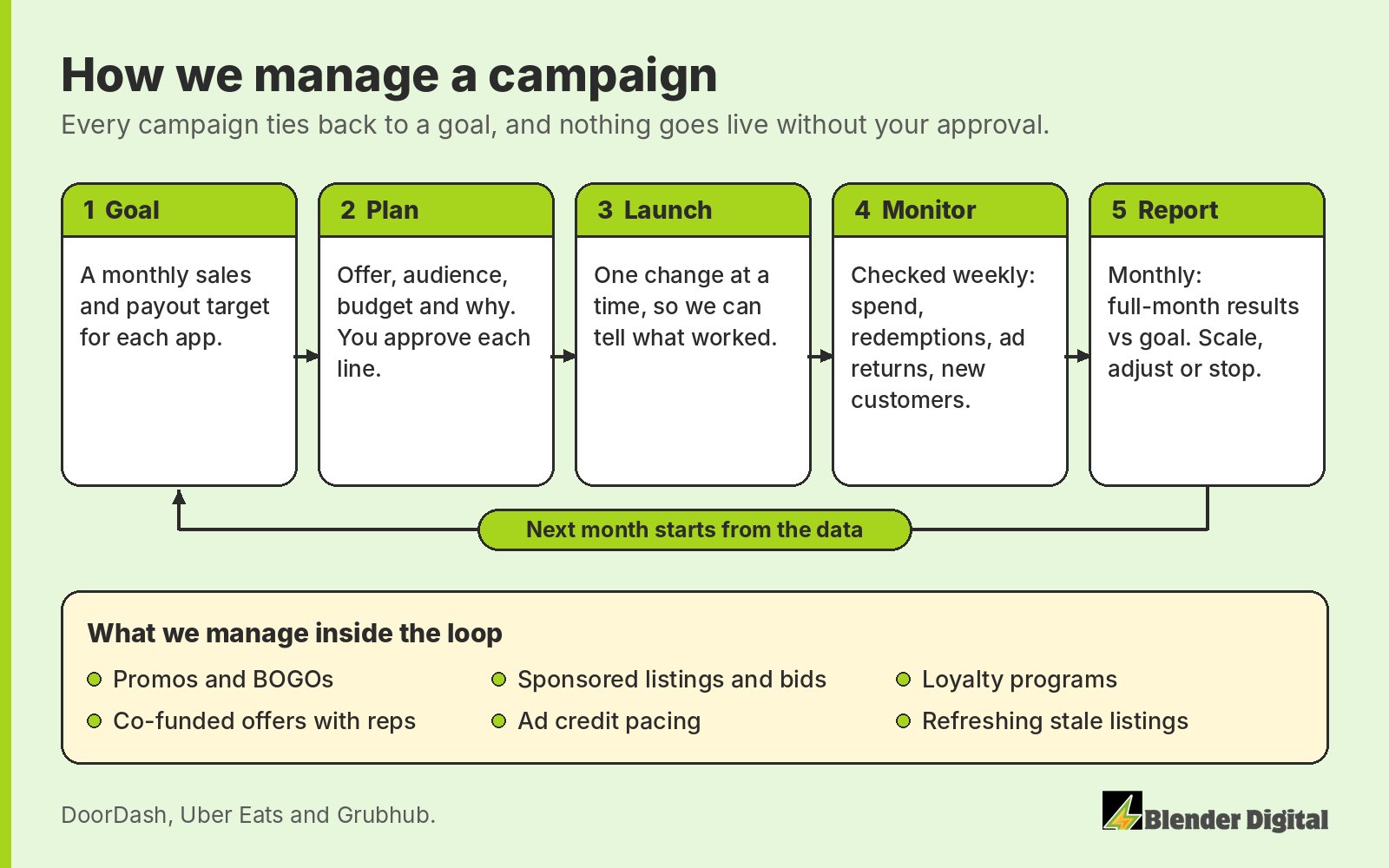
The same loop every month. A goal, a plan you approve, one change at a time, and a full month of data before we decide what to scale.
Audit what's already running
In the first two weeks we go through your live campaigns and who they target, your customer mix, which menu items can carry a discount, and what the platforms are charging you.
Write the plan and get your approval
Each recommendation comes with the offer, the audience, the budget and the reason. There's an approval line under every one. You approve it, decline it, or tell us what to change.
Launch one change at a time
If we change the menu, the prices and the offers in the same week, nobody can tell what moved the numbers. We stage changes so each one can be measured.
Monitor weekly, adjust in small steps
Budgets move 10 to 20 percent at a time, with a week or two between moves so the algorithm can settle. A bad Tuesday is not a trend.
Report monthly, then scale or stop
Full-month results go against the goal. What's working gets more items or more budget. What isn't gets cut. Once growth goals are hit, the focus shifts to keeping more of each sale.
Work the platform reps
We bring the hard questions to account managers: co-funding, credits, credit-backs when their campaigns break, and a better commission when your volume earns it.
WHAT WE TRACK
Which numbers tell us a campaign is working?
Payout ratio comes first. Sales that never reach your bank account aren't the win they look like. The rest explains why payout moved.
Payout ratio
Net payout divided by sales. Around 50% is respectable in a heavy growth phase, 60% is good, and 70 to 85% is the ceiling with no promos at all.
Sales against goal
Full calendar months against the monthly target we agreed, split into more orders versus bigger orders.
Cost per new customer
What each first-time customer cost in discounts and ads. A new customer can only be new to your store once, so this is the number worth paying for.
Ad return
Sales per dollar of ad spend. DoorDash and Uber Eats calculate it differently, so each platform gets its own yardstick.
Click-through and click-to-order
How many people who see the ad tap it, and how many who tap it order. Healthy Uber Eats ads run around 5% and 11 to 12%.
Effective discount
Marketing cost as a share of sales. Threshold offers stay at or under about 25%, or the margin goes with them.
Repeat orders
How many new customers come back within 30 days. Around 15% after a new-customer BOGO is a good sign.
Redemptions by item
Which BOGO items pull orders and which only pull discounts, so the item list improves each month.
Spend and credits
Weekly budget pacing, underspend, and any platform credits that need to be used before they expire.
Want the definitions in more depth? Read Delivery metrics explained.
IN PRACTICE
What does this look like in a real month?
Three results from recent engagements, each with its time window and platforms. Clients are anonymized.
ONE PLAN
Campaigns, reviews, errors and reporting in one plan
Campaigns don't run in isolation. A BOGO that doubles orders also doubles the chances of a missing item, and a run of bad reviews makes every ad dollar work harder. That's why campaign management sits inside one plan with the rest of the channel.
Separate vendors
- One person runs ads, another tool handles reviews, a recovery service chases error charges
- Each vendor is measured on its own task
- Nobody connects a promo spike to the errors and reviews that follow
- You stitch the reports together yourself
One Blender Digital plan
- Campaigns, sponsored listings, loyalty and rep negotiations
- Every review answered, with offers that bring customers back
- Error charges reviewed daily, disputes prepared for you to submit
- One monthly report, measured on sales growth and payout
FAQ
Campaign management questions
What does delivery campaign management include?
Everything that costs you money to bring in orders on DoorDash, Uber Eats and Grubhub: promotions and BOGOs, sponsored listings and their bids, loyalty programs, co-funded offers with platform reps, and ad credits. We set them up, check them every week, report on them every month, and tie each one back to a goal you agreed to.
Do you change campaigns without asking me?
No. Every recommendation comes to you in writing with an approval line under it. You approve, decline or send feedback, and only then does anything go live. If you decline something, it moves to a later month. We don't argue it in the background.
Is ad spend included in your fee?
No. Ad spend and offer costs are paid to the platforms and come out of your payouts. Our fee covers the management. We start budgets low (Uber Eats ads from about $3 a day, DoorDash sponsored listings from a $3 manual bid where the market allows it) and only raise them when the return earns it.
How soon will I see results?
Many restaurants see measurable changes within 30 to 60 days. We usually let the first month run untouched so there is a full month of clean data, then scale what is working. We judge results on full calendar months, because the apps swing from day to day.
Do you work with my DoorDash or Uber Eats account manager?
Yes. We ask reps for co-funding and ad credits, check every campaign they build before it runs, and turn down suggestions that don't fit your numbers. Reps can be helpful, but they work for the platform. Someone should be checking their work on your behalf.
Want a second set of eyes on your campaigns?
In a free 30-minute call we'll look at what you're running on DoorDash, Uber Eats and Grubhub, and tell you what we'd keep, change or turn off.