
No. Owner.com is good at getting your restaurant found on Google and giving your regulars a branded app to reorder from, but it can't replace DoorDash and Uber Eats. DoorDash alone had over 56 million monthly active users in December 2025, and DoorDash says 55% of first-time orders on its app come from people who were browsing, not looking for a specific restaurant.
I manage DoorDash, Uber Eats, Grubhub and Toast for restaurants, and some of my clients run Owner.com too. I like the product. What I push back on is its marketing, where the delivery apps are the villain and your own website is the way out.
Quick answer
- What Owner.com does well: your website, Google SEO, online ordering, a branded app and loyalty.
- What it can't do: put you in front of people who have never heard of you and are scrolling DoorDash or Uber Eats.
- Who downloads your app: regulars. Owner.com's own page says "Roughly 1 in 2 of your regulars will download your app."
- Why the apps are sticky: one login, one saved card, every restaurant on the app.
- My setup: marketplaces find the customers, your own site keeps them.
What is Owner.com good at?
Owner.com builds your restaurant website, online ordering, a branded mobile app, automated SEO pages, loyalty and rewards, and email and text marketing. Its pricing page lists all of that on both plans. The headline on its homepage reads "The AI platform restaurants use to grow online discovery."
The SEO part is real, in my experience. When an owner asked me on a call in September whether to move his ordering from Owner.com to Toast, my answer was that Owner.com is the specialist here: "Owner became specialized. They became really good at it." If your Owner.com site is bringing in organic Google orders, keep it.
For the cost side, I break down the plans in is Owner.com worth it.
Who actually downloads a restaurant's app?
Your regulars. Owner.com says so itself. Its branded app page says "80% of your regulars want apps from their favorite restaurants" and "Roughly 1 in 2 of your regulars will download your app." The page doesn't give a source for either number, but look at the word it picked. Regulars.
The person who orders from you every Thursday will download your app and reorder in two taps. That's who a branded app is for, and it's a good way to move them off a 25% commission.
A lot of people want variety, though. Tacos one night, sushi the next, somewhere new on Sunday because a friend posted about it. Nobody downloads an app for every restaurant they try once. When an owner tells me they want to get off the apps and build their own, I ask one question: what about the more casual eater? They're not on your app. They're on DoorDash.
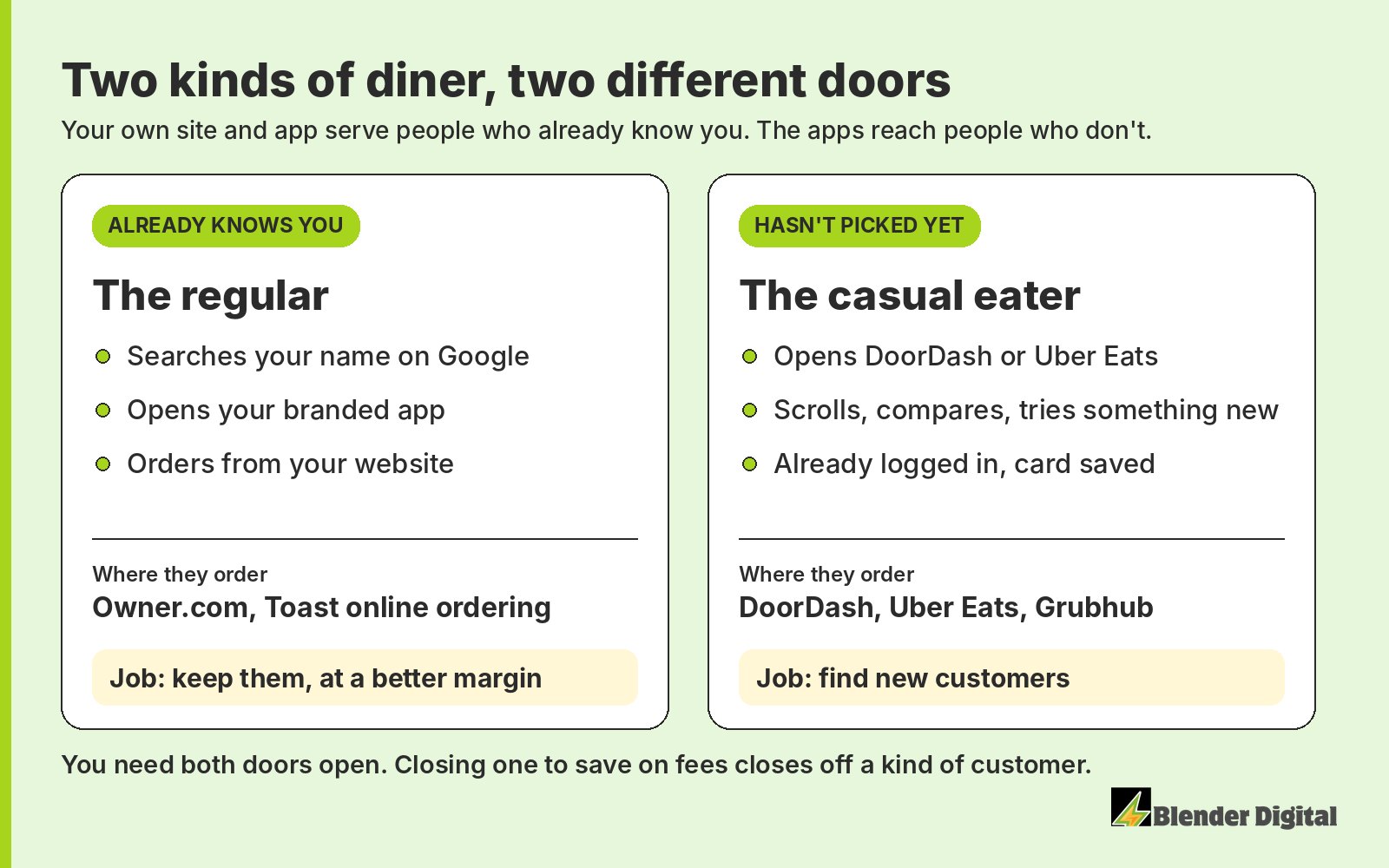
Isn't Google where people find restaurants?
Google is one door. It's a big one, and for people searching your name or "tacos near me," Owner.com's SEO is built to win it. But a lot of discovery happens inside the delivery apps, where Google never sees it.
DoorDash's 2026 Restaurant Industry Trends Report, made with SevenRooms from a Dynata survey of 3,001 US consumers in March 2026, says 55% of first-time orders on DoorDash came from consumers who were browsing, not looking for a specific restaurant. The same survey says 22% of consumers have used AI to choose a restaurant (DoorDash trends report). That's DoorDash's own survey, so read it that way. It still matches what I see: new-customer offers on the apps keep bringing in people who had never ordered from the store.
To be fair to the other side, the apps carry your regulars too. A 2023 PYMNTS survey of 2,288 US consumers found that 58% of engaged delivery app users had picked their restaurant before opening the app most or all of the time (PYMNTS). Those are the people a bag card and a branded app can win over. The rest are scrolling, and they aren't typing your name into Google.
That's my problem with the pitch. The market isn't one big Google search. It's split across Google, social, AI search and the apps, and the apps spend billions to keep people inside them.
How big are DoorDash, Uber Eats and Grubhub?
These are the companies the "leave the apps" pitch asks you to walk away from. Figures are each company's own reported numbers for 2025, and they're global.
| Company | Orders through the app | Users and members | Sales and marketing spend, 2025 |
|---|---|---|---|
| DoorDash | $102 billion in Marketplace GOV across the four quarters of 2025, from 3.17 billion orders | 56M+ monthly active users (Dec 2025); 35M+ DashPass, Wolt+ and Deliveroo Plus members | $2.48 billion (Q4 2025 results) |
| Uber Eats | $25.4 billion in Delivery gross bookings in Q4 2025 alone, past a $100 billion annual run rate | 46M+ Uber One members; 202M monthly active users across Uber | $4.90 billion, whole company (Q4 2025 results, prepared remarks) |
| Grubhub | Private since Wonder agreed to buy it for $650 million in November 2024 | 375,000+ merchants at the time of the deal | Not reported (Nation's Restaurant News) |
A few notes so nobody misreads these. DoorDash's numbers include Wolt and, from late 2025, Deliveroo. Uber's membership, user and marketing numbers cover rides as well as delivery. DoorDash also spent $1.43 billion on research and development in 2025, which pays for the stuff that keeps people ordering inside the app: saved addresses, saved cards, reorder buttons and membership perks.
Grubhub is much smaller, usually 5% to 10% of a store's app sales in the markets I work in.
Why does one login matter so much?
On DoorDash or Uber Eats, a customer logs in once. Their address, card and membership work at every restaurant on the app. Trying a new place costs them one tap.
Toast figured this out on the first-party side. Toast's support site says guests can "create a single account that can be used across all Toast Online Ordering sites" (Toast support), and the same login works in the Toast Local app, formerly Toast Takeout (Toast Local FAQ). One account, many restaurants.
An Owner.com site is built for one restaurant. Each Owner.com restaurant runs its own sign-in on its own domain, tied to that restaurant's loyalty points. There's no Owner.com guest account, no Owner.com app for diners and no marketplace tying the restaurants together, and nothing on Owner.com's help center says a login carries from one restaurant to the next. So a first-time guest makes an account and types in a card just for you. Your regular will do that. The casual eater usually won't. "You can't convert convenience factor."
Is it fair to make the delivery apps the villain?
Owner.com's marketing leans hard on fees. Its homepage quotes a customer saying, "We no longer have to pay 25% to 35% in commission fees and promo fees for the same revenue." Its branded app page promises "Zero commission online orders."
The fees are real. I write about them all the time, and a delivery app order will never be your most profitable order. But in my opinion, painting DoorDash and Uber Eats as the boogeyman misleads owners about how customers find restaurants. It treats discovery as one Google search, when it's a fight for attention, and the apps are some of the best-funded players in it.
Here's the line I'd point owners to. Owner.com's own pricing FAQ says, "Most of our customers use third-party apps alongside Owner." That's the right answer. I just wish the ads said it as loudly as they talk about commission.
How should Owner.com and DoorDash work together?
Give each channel a job.
- DoorDash, Uber Eats and Grubhub find new customers. Treat the commission as what it costs to get them. "It's not about buying the additional order. It's about buying the new customer."
- Owner.com or Toast online ordering keeps them. That's where the margin is.
- The bag connects the two. Put a card with a QR code in every marketplace order. Expect 10% to 20% to switch.
Here's what the front door looks like when it's working. In September 2026, a first-order BOGO brought 189 new customers on Uber Eats to a fast-casual franchise in New Jersey we manage, with $8,858 in sales on $3,465 of offer cost. Every one of those people got a bag, and the bag is where you ask them to order direct next time.
I go deeper on the split in third-party vs first-party delivery, and on tracking first-time customers in how to see new customers on DoorDash and Uber Eats.
FAQ
Can Owner.com replace DoorDash and Uber Eats?
No. Owner.com runs your website, online ordering and branded app, which serve people who already know you. DoorDash and Uber Eats put you in front of people browsing for something to eat. Owner.com's own pricing FAQ says most of its customers use third-party apps alongside it.
Do customers actually download restaurant apps?
Regulars do. Owner.com's branded app page says "Roughly 1 in 2 of your regulars will download your app." People who try lots of different restaurants rarely download an app for each one, so a branded app is a way to keep customers, not to find new ones.
Where do people find new restaurants to order from?
Google, social media, AI tools and the delivery apps. DoorDash's 2026 Restaurant Industry Trends Report, based on a Dynata survey of 3,001 US consumers, says 55% of first-time orders on DoorDash came from people who were browsing, not looking for a specific restaurant.
Does one Toast account work at other restaurants?
Yes. Toast's support site says guests can create a single account that can be used across all Toast Online Ordering sites, and the same login works in the Toast Local app, formerly Toast Takeout.
Is Owner.com better than Toast online ordering?
In my experience Owner.com is stronger on SEO and marketing. Toast's edge is one guest account across every Toast restaurant and ordering inside your POS. I tell owners not to switch to Toast just to get loyalty in one system if Toast can't match the Google traffic Owner.com already brings in.
Running Owner.com or Toast online ordering and want the marketplaces working as your front door? That's what we do, and we don't compete with your first-party platform. Send me a full month from each app and I'll tell you what I see. Get in touch here.